
The Phalanx Principle: What Ancient Greece Can Teach Your Firm About Never Missing a Deadline
⏱ 8 min read 📚 Strategy & Operations 🗓 Duetiful Blog
Two thousand years before the modern law firm, Greek soldiers had already solved the problem that kills professional practices today: the catastrophic cost of a single person standing alone. Their answer, the phalanx, was not a tactic. It was a philosophy. The Romans later proved its value in the most brutal way possible: by destroying it.
The Formation That Conquered the Ancient World
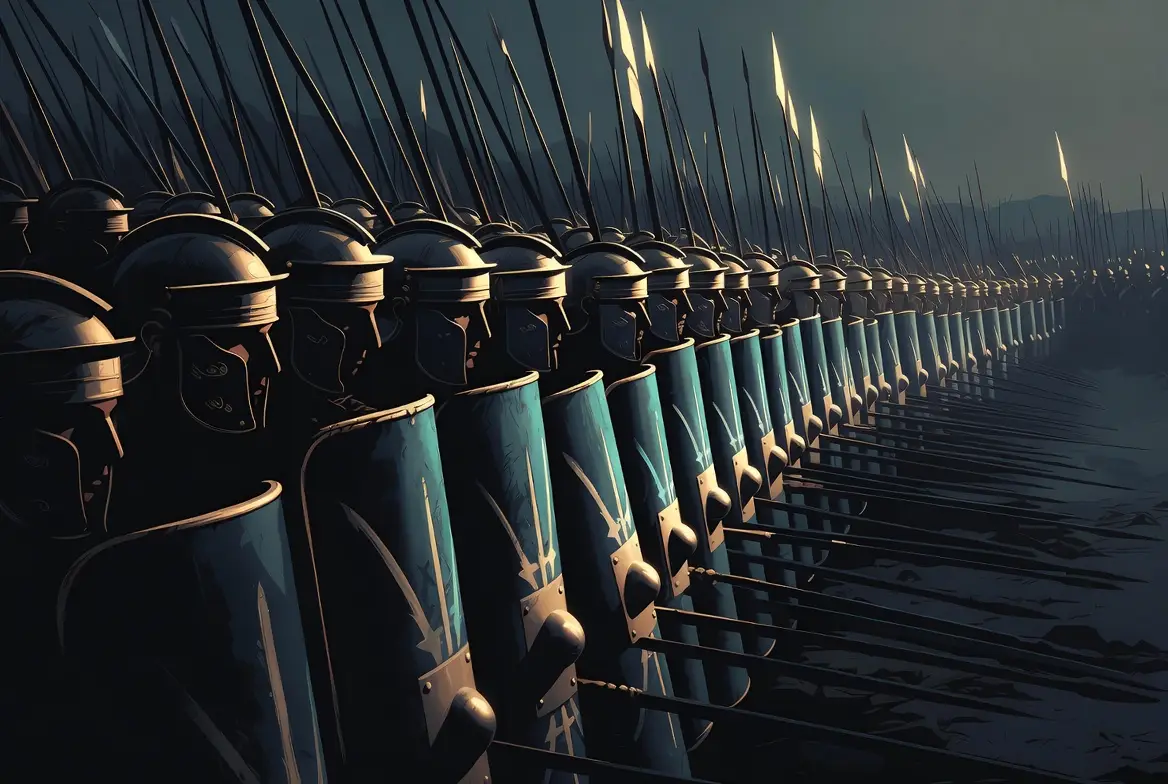
The phalanx was a Greek invention. City-states built their military identity around it. Rows of soldiers, shields locked edge to edge, spears extended in overlapping layers. Each man's shield covered not only his own left side but the exposed flank of the soldier beside him. Remove one, and the wall had a gap. Leave the gap long enough, and the wall fell.
Alexander the Great used it to cut through Persia, Egypt, and into the subcontinent. For over a century, no force on earth could break a well-held phalanx from the front. From a distance, it appeared impenetrable. Invincible. Eternal.
🛡🛡🛡🛡🛡🛡🛡🛡
🛡🛡🛡🛡🛡🛡🛡🛡
🛡🛡🛡🛡🛡🛡🛡🛡
The phalanx formation: each shield protected not just its bearer, but the soldier to his left. Remove one, and the wall falls.
Then came the Battle of Pydna in 168 BC. The Macedonian phalanx, descendant of Alexander's, met the Roman legion on uneven ground. The terrain broke the formation's spacing. Gaps opened between units. The Romans, fighting in smaller flexible groups, poured into every gap they found. What had been a wall of iron became a collection of isolated men. The Macedonians were destroyed in under an hour.
The lesson Rome took from Pydna was not that the phalanx was weak. It was that the phalanx was only as strong as its ability to hold together. United, it had conquered the known world. Divided, it collapsed against an enemy it would have otherwise repelled with ease. The philosophy underlying the formation was also the instruction manual for defeating it.
Historical Context
Greek city-states built entire civic identities around the phalanx. The word itself became synonymous with unified civic will. Aristotle noted that the polis could only function when citizens understood their obligations to one another as structural, not optional. The Spartans at Thermopylae held a mountain pass against an army many times their size for three days, not through individual heroism, but through a formation that made every soldier structurally responsible for the man beside him.
What Rome Did Next
Rome did not look at the wreckage at Pydna and conclude that cooperative structure was a failed idea. They concluded the opposite. The phalanx's cooperative principle was sound. Its rigidity was the liability. So they kept the principle and discarded the brittleness.
The result was the manipular legion. Instead of one unified block, the Roman army was reorganised into smaller independent units called maniples. Three lines, each with a distinct role. The hastati up front absorbed the initial impact. The principes behind them reinforced or replaced as needed. The triarii, the most experienced soldiers, held in reserve as the last line of response. Each maniple could advance, withdraw, pivot, or fill a gap without the entire formation having to move. On broken ground, where the phalanx seized up, the legion adapted.
The Roman Refinement
Rome did not abandon the shield overlap that made the phalanx dangerous. The scutum, the large rectangular Roman shield, was still designed to cover the man to the left in close formation. The testudo formation locked shields on all sides and overhead for siege approaches. What Rome discarded was the single rigid line. What it kept was layered, cooperative coverage with graduated response: individual, then peer, then reserve.
This is the mature version of the same idea. The phalanx was the first-generation model: powerful when conditions were perfect, catastrophic when they weren't. The legion was the second generation: the same cooperative logic, rebuilt for resilience. The shield overlap survived. The single point of failure did not.
Two Armies, One Principle
The Greek phalanx and the Roman legion look nothing alike on paper. One is a dense unified block; the other is a flexible tiered system. But both rest on the same architectural truth: no soldier covers only himself. The difference is that Rome engineered for the moments when the formation comes under pressure it didn't expect. That is exactly the condition a professional firm faces when a matter escalates, a key person is out, or a deadline arrives earlier than anyone realised.
"United We Stand, Divided We Fall": And What That Actually Means
The phrase is older than the American founders who popularized it. Its earliest traceable form appears in Aesop's fables: a father shows his sons that a single stick breaks easily, but a bundle of sticks cannot be snapped. The lesson was not merely motivational. It was architectural.
"United we stand, divided we fall" is not a rallying cry. It is an engineering specification. The phalanx understood this before the phrase was ever coined
Most professional organisations interpret this adage as a call for team spirit: goodwill, morale, a Friday afternoon drink. This misses the point entirely. The phalanx did not work because soldiers liked each other. It worked because each soldier's survival was structurally dependent on the actions of the person beside him.
That is a fundamentally different proposition. Goodwill is optional. Structural dependency is not. In the phalanx, you covered your neighbor's left flank not because you were fond of him, but because the alternative (his death) meant the exposure of your own right side. Cooperation was not a virtue. It was a survival mechanism built into the architecture of the formation itself.
The Structural Insight
The phalanx's genius was not that it made soldiers braver. It made individual courage almost irrelevant, because the formation's strength came from its interlocking design, not from the heroism of any single person within it. The system was the hero.
The Modern Professional Practice: A Phalanx With Gaps
Now consider the modern law firm, accounting practice, or immigration consultancy. On any given morning, dozens of deadlines are in motion: court filings, tax lodgements, visa applications, compliance reports. Each one is, at that moment, sitting in a single person's inbox, calendar, or memory.
This is the professional services equivalent of a soldier standing in the battle line with no shield on his left. The work is there. The professional is capable. But they are standing alone.
🚩 The Single Point of Failure Problem
When a deadline lives exclusively with one person, in their personal calendar, their email drafts folder, their memory. The entire organisation is exposed to that person's availability, health, attention, and luck on any given day. This is not a people problem. It is a structural problem. The phalanx would call it what it is: a gap in the line.
The statistics bear this out with brutal clarity. Missed deadlines are the #1 cause of professional malpractice claims across law, accounting, and financial services. In over 80% of cases, the root cause is not negligence. It is a breakdown in handoff, a gap in coverage, a single person who was sick, distracted, or simply overwhelmed on the wrong day.
Translated into phalanx terms: the shield dropped. And because no one was structurally assigned to cover that position, the line broke.
Why "Just Be More Organised" Is Bad Tactical Advice
The instinctive response to missed deadlines is to prescribe better individual organisation. Use a better calendar. Set more reminders. Be more diligent. This is the equivalent of telling a soldier in a broken phalanx to "hold his shield higher." It may help at the margins. It does not fix the formation.
| Approach | The Individual Model | The Phalanx Model |
|---|---|---|
| Accountability | Rests with one person | Distributed across two |
| Failure mode | Single point of failure | Requires two simultaneous failures |
| Visibility | Hidden in personal systems | Shared across the team |
| Resilience | Breaks when person is unavailable | Holds when one person is out |
| Trust model | Hope the individual performs | Build the system to catch failure |
The fundamental problem with the individual model is not the quality of the individuals inside it. Most professionals in private practice are highly capable, deeply motivated, and genuinely conscientious. The problem is the system itself. It places the entire weight of a firm's compliance obligations on one person with no structural backup, then acts surprised when, under the cumulative pressure of a full caseload, something falls through.
You would not build a bridge with a single load-bearing cable and call it safe. You should not manage professional deadlines the same way.
Cooperative Accountability: Building the Professional Legion
The Greeks designed cooperation into their formation at the level of the shield. The Romans took that principle and added depth: a primary line, a support line, a reserve. Each layer existed to cover the failure of the one in front of it. Neither army left a gap unattended. Neither left a soldier to stand alone.
Cooperative accountability works the same way. It is not about creating a culture where colleagues kindly check in on each other's work. It is about designing a system where every deadline has layered coverage: a primary owner who carries the work, a backstop structurally assigned to step in if needed, and a clear escalation path before any breach occurs.
The Backstop Principle
In a well-designed phalanx system, every critical deadline has a secondary guardian: a colleague who is informed, aware, and structurally positioned to step in. This doesn't create redundant work. It creates a safety architecture where a single point of failure is geometrically impossible. Two people would have to miss the same deadline at the same time for the line to break.
The effect is not just reliability. It changes how accountability feels inside the organisation. In a single-person model, accountability is anxiety-inducing. Everything rests on you. In a phalanx model, it is collaborative. You know someone has your back. And that knowledge changes how you perform.
Research in organisational psychology consistently shows that teams with mutual accountability structures outperform individuals by up to 65% on complex multi-step tasks. The phalanx is not just safer. It is more effective.
The Psychological Shift
There is a second-order benefit to the phalanx model that ancient commanders understood intuitively: soldiers fight better when they know someone is covering their blind side. The same is true for professionals. A lawyer who knows a colleague has visibility over their critical filings is not just protected. They are free to do their best work, rather than burning cognitive bandwidth on anxiety about what they might be forgetting.
The Phalanx Effect in Practice
What does this look like inside a professional practice? Not meetings. Not check-ins. Not another calendar system layered onto the last one. The phalanx effect emerges when accountability is built into the workflow itself: when the act of recording a deadline simultaneously notifies, involves, and arms the backstop.
Consider a legal professional carrying 40 active matters. Each file has its own critical dates: court filing windows, limitation periods, review deadlines, reporting obligations. Today, most of those dates live in one person's head or their personal calendar. The phalanx model says every one of those dates should be visible to at least one other person, structurally positioned to act if the primary handler cannot.
The Three Conditions of a Professional Legion
1. Shared visibility: Every deadline in the organisation is visible to more than one person. Not as a courtesy, but as a system requirement.
2. Designated coverage: Every critical deadline has a named backstop. Not "the team generally" but a specific individual with a specific role.
3. Graduated escalation: When a deadline approaches without being actioned, the system itself escalates: first to the primary, then to the backstop, then to a team lead. Before the breach occurs, not after.
These three conditions, taken together, replicate the structural logic of the phalanx in a professional services context. They do not depend on individuals being heroes. They build a system that makes heroics unnecessary, because no gap in the line is ever left uncovered.
Where Duetiful Fits Into the Formation
This is the philosophy at the heart of Duetiful. Not a reminder app. Not a task manager. A cooperative accountability platform designed to bring the structural logic of the phalanx to professional deadline management.
Duetiful's Backstop System is, at its core, an architectural answer to the single point of failure problem. Every deadline recorded in Duetiful has a primary owner and an assigned backstop. The system monitors progress, sends graduated reminders, and escalates to the backstop before a breach occurs. Not after. The shield is always extended. The line never has a gap.
Duetiful's Backstop System
When a critical deadline is entered into Duetiful, the system doesn't just remind the owner. It loops in the assigned backstop colleague, ensures they have the context to act if needed, and escalates through a pre-set chain before the deadline is ever missed. This is not surveillance. It is structure. The same structure that made the phalanx unbreakable.
The result is a team that operates less like a collection of individual professionals and more like a formation. Each person still carries their own work, their own expertise, their own caseload. But no one carries it alone. The shields are interlocked. The line holds.
And just as the phalanx soldier fought better knowing someone was covering his left flank, the professional performs better knowing the system is built to catch what they might miss. Cooperative accountability is not a burden. It is a weight shared, and therefore lighter.
A single stick breaks. A bundle holds. The ancient wisdom was never about motivation. It was about architecture. Build the bundle, and strength follows.
The Firms That Will Win the Next Decade
Professional services is entering a decade of increasing complexity. Regulatory requirements are multiplying. Client expectations are rising. The margin for error in deadline management is contracting toward zero. In this environment, the practices that will thrive are not the ones with the most talented individuals. They are the ones with the most resilient formations.
The individual star model is the brilliant partner who holds everything in their head and somehow delivers. It is a liability dressed as an asset. That partner is a single load-bearing cable. When they leave, burn out, or have a bad month, the bridge falls.
The phalanx model: distributed accountability, structural coverage, cooperative ownership of every critical date. It is the architecture of the firms that will not just survive the next decade, but scale confidently through it. United they will stand. Not because they are motivationally committed to standing together, but because the system makes standing alone structurally impossible.
The Competitive Advantage
Professional practices that implement formal mutual accountability systems report not only fewer missed deadlines, but measurable improvements in staff retention and client satisfaction. The phalanx effect is not just operational. It is cultural. Teams that cover each other's backs build trust faster, onboard new hires more effectively, and are significantly more resilient during periods of high volume or unexpected staff absence.
• • •
Build Your Firm's Phalanx
Duetiful gives every deadline a primary owner and a structural backstop, so no critical date is ever left standing alone.
- Free trial : 14 days, no commitment
- Set up in under 10 minutes
- Built for law, accounting & migration
About Duetiful: Duetiful is a cooperative deadline management platform built for professional services firms. Our Backstop System ensures every critical deadline has structural coverage, so teams can deliver reliably at scale, without the anxiety of single points of failure.
References & Further Reading
- Polybius, The Histories, Book XVIII. Account of the Battle of Pydna and the phalanx's structural limitations
- Aristotle, Politics, Book I. On the structural obligations of citizens within the polis
- American Bar Association, Profile of Legal Malpractice Claims 2020–2023. Deadline and calendar management as leading malpractice cause
- Harvard Business Review, The Power of Accountability Partnerships. Research on mutual accountability in high-performance teams
- Association of Accounting Technicians, Practice Risk Management Report 2024. Deadline failures in accounting practice
- Aesop, The Bundle of Sticks. Original source of the "united we stand" structural metaphor
Comments